


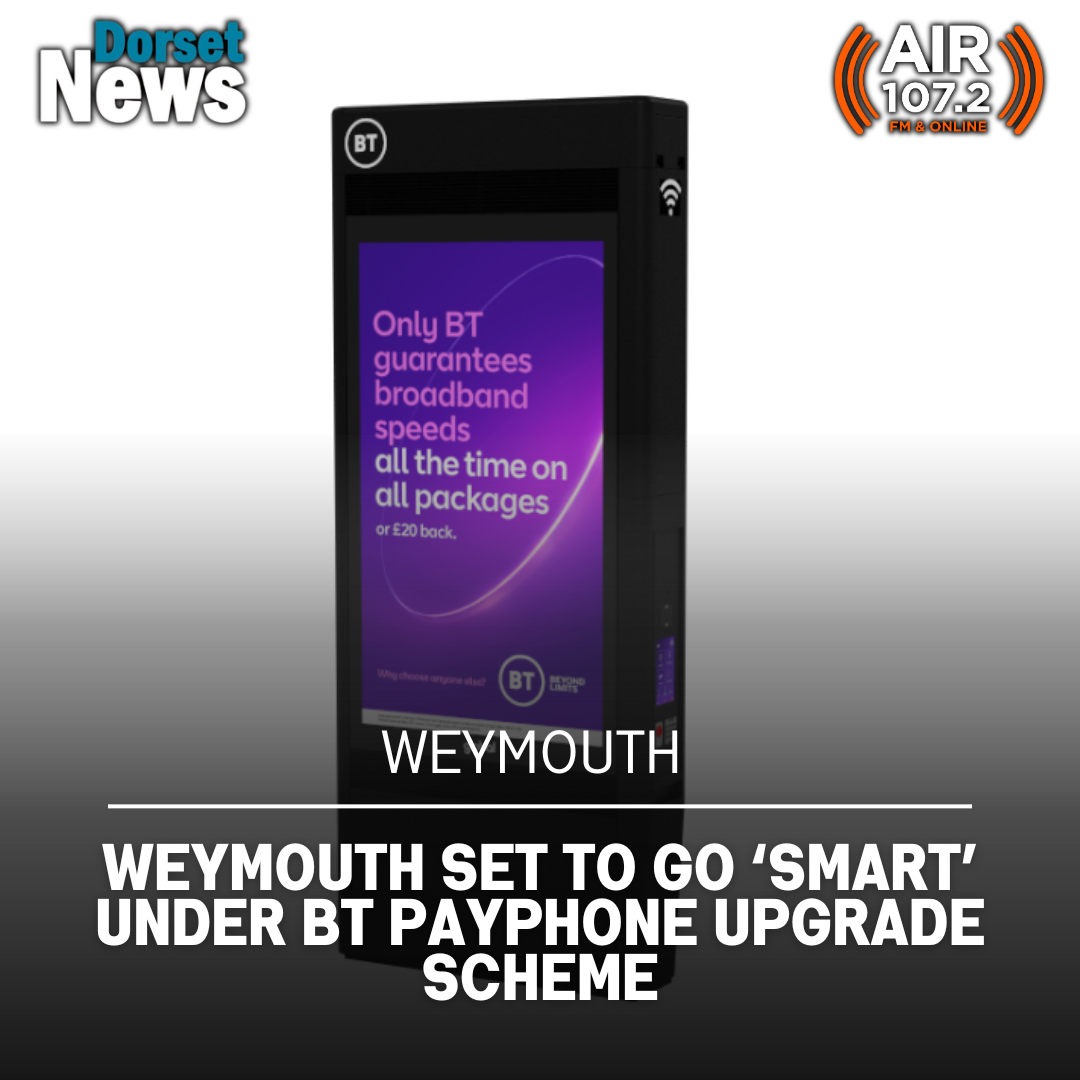
Two familiar pieces of street furniture in Weymouth could soon be on their way out.
Planning applications have been submitted to remove existing BT payphones and replace them with new BT Street Hubs (sometimes described locally as “smart hubs”) at St Mary Street and the Esplanade. One recent local report says BT’s St Mary Street proposal would be located at the current payphone site outside 104 St Mary Street, with advertising proposed on the unit.
While the final decision will sit with the local planning authority, the proposals tap into a wider national shift: as traditional payphone use has collapsed, telecoms firms are increasingly replacing old kiosks with multifunction “digital street” units designed to offer public connectivity and generate revenue through advertising.
What is a BT Street Hub?
A BT Street Hub is a tall, freestanding digital communications kiosk intended to replace legacy phone boxes and provide several free public services in one place.
Based on BT’s own description of Street Hubs, the core features typically include:
- Free UK phone calls (to landlines and mobiles)
- A touchscreen/tablet interface for local information, maps and navigation
- Free rapid device charging via USB ports
- Free public Wi-Fi, marketed as ultrafast and supported by fibre backhaul, with some designs also supporting 4G/5G “small cell” capability
Many Street Hub proposals also include two large digital display screens, typically used for advertising and public messages. A BT Street Hub product statement describes units as having HD screens on two sides, and gives indicative dimensions of roughly 2.98m tall with a relatively narrow footprint.
What do they actually do day-to-day?
Think of a Street Hub as a “public connectivity pillar”:
Call function (free in the UK)
Instead of dropping coins into a payphone, you can make free calls to UK numbers from the unit.
Wi-Fi hotspot
The hub broadcasts public Wi-Fi, intended to help residents and visitors who need data—especially in busy centres and seafront areas.
Charging point
USB charging ports let people top up their phone battery while waiting for buses, meeting friends, or visiting the beach/town centre.
On-street information and wayfinding
A touchscreen provides local information—often including maps, routes and nearby services—designed to support visitors as well as locals.
Advertising screens (commonly part of the business model)
BT’s planning and promotional materials commonly describe advertising displays as integral to funding the rollout and maintenance of these hubs.
Planning Portal
Why BT is replacing payphones
Traditional payphone demand has fallen dramatically over the years, but BT argues there is still a need for free-to-use public communications, especially for people without reliable mobile data, low battery, or during emergencies.
Street Hubs are presented as an upgrade: instead of “a phone box that few people use,” the replacement provides Wi-Fi, charging, calls, and information services in one unit.
Crucially, BT also positions Street Hubs as cost-neutral to the public purse, because rollout and upkeep are funded through digital advertising revenue rather than local taxation.
The Weymouth proposals: St Mary Street and the Esplanade
The applications submitted for Weymouth focus on removing existing payphones and installing new BT Street Hubs in their place.
St Mary Street, Weymouth: A local report states BT wants the unit at the payphone site outside 104 St Mary Street, and that the proposal includes double-sided advertising.
The Esplanade, Weymouth: A separate proposal has been reported as seeking a hub on the promenade, again replacing a payphone, reflecting a pattern seen nationally where seafront and high-footfall sites are targeted for hubs.
Pros: what supporters say Street Hubs could improve
Better connectivity in busy public areas
For visitors and residents, free Wi-Fi can be genuinely useful—especially in town centres and along the seafront where footfall is high. BT also promotes the idea that hubs can support improved mobile connectivity via small-cell capabilities in some deployments.
A modern “public phone” for emergencies
Even in a smartphone era, a free-to-use street phone can help if someone has no credit, a dead battery, or needs help quickly. BT highlights easy access to phone services and emergency contact options as part of the concept.
Device charging on the go
Charging points may sound minor, but in practice, they’re one of the most-used public amenities—especially in tourist locations.
Wayfinding and local information
For a seaside town with seasonal tourism, a touchscreen providing maps, routes, and local services could help visitors navigate—potentially reducing pressure on visitor centres and local businesses fielding basic directional questions.
No direct cost to the council
BT’s stated model is that hubs are deployed and maintained using advertising revenue, rather than council funding.
Cons: the common objections (and why planners scrutinise them)
Visual impact and “street clutter”
A Street Hub is typically taller and more visually prominent than many older payphone structures, and is often installed in conservation-sensitive areas (town centres, historic streets, seafront promenades). A BT product statement sets out a tall form factor (around 3m) designed to maximise Wi-Fi range, which can become a key planning issue in tighter streetscapes.
Digital advertising: brightness, distraction, and character
The inclusion of large, illuminated ad screens is often the flashpoint. Even when some content is reserved for public messaging, the commercial advertising is the funding mechanism—meaning screens are not a side feature but a central part of the scheme.
Planners may look closely at:
- impact on the character of the area
- night-time brightness and amenity
- driver/cyclist distraction risks (depending on siting)
- whether public realm is being “sold off” to advertising
- Privacy and “smart city” concerns
Some campaign groups and residents elsewhere have raised concerns about the broader “smart infrastructure” direction of these kiosks (for example, what data is or isn’t collected and how the screens are used). Even when the hub’s core functions are benign, public trust can become a live issue and lead to calls for transparency.
Anti-social behaviour and safety perceptions.
Any street feature where people may linger (charging, sheltering, gathering) can attract worries about anti-social behaviour—particularly in areas that already experience evening-time issues. This tends to be debated locally and can influence conditions around lighting, maintenance, and exact placement.
Maintenance and reliability
A payphone is relatively simple; a hub combines screens, electronics, connectivity, charging ports, and software. If not properly maintained, broken screens/ports can quickly become an eyesore and frustrate the public—another factor councils may press BT on through planning conditions or side agreements.
Discover more from Dorset News
Subscribe to get the latest posts sent to your email.









Leave a Reply